
The Excitement and Pitfalls of Odoo 20
With Odoo 20 on the horizon, business leaders and system administrators worldwide are eagerly evaluating whether to install and upgrade to the latest release as soon as it becomes available. Odoo ERP continues to innovate rapidly, offering enhanced workflows, fresh features, and performance boosts across its enterprise suite.
However, as an official Odoo Silver Partner in Pakistan, Odocore frequently counsels clients on balancing technological enthusiasm with operational stability. While installing Odoo 20 manually on day one is technically possible, jumping straight into a day-one upgrade is rarely the right strategic move for most businesses.
Before migrating your live production environment to Odoo 20, it is critical to evaluate the real costs, risks, and human factors involved in early software adoption.
Hidden Cost #1: The Human and Operational Toll on Your Team
When evaluating an ERP upgrade, many organizations focus strictly on direct financial expenses. However, software upgrades carry hidden operational costs that go far beyond dollars and cents.
Upgrades Are "Mini-Implementations"
Recalling your initial Odoo ERP implementation highlights how challenging it was for your organization to adapt to new workflows, establish standard procedures, and build staff confidence. Software change management relies heavily on the "soft element"—your employees. Getting team members to feel secure, trained, and productive in their daily tasks is often the hardest part of any ERP project.
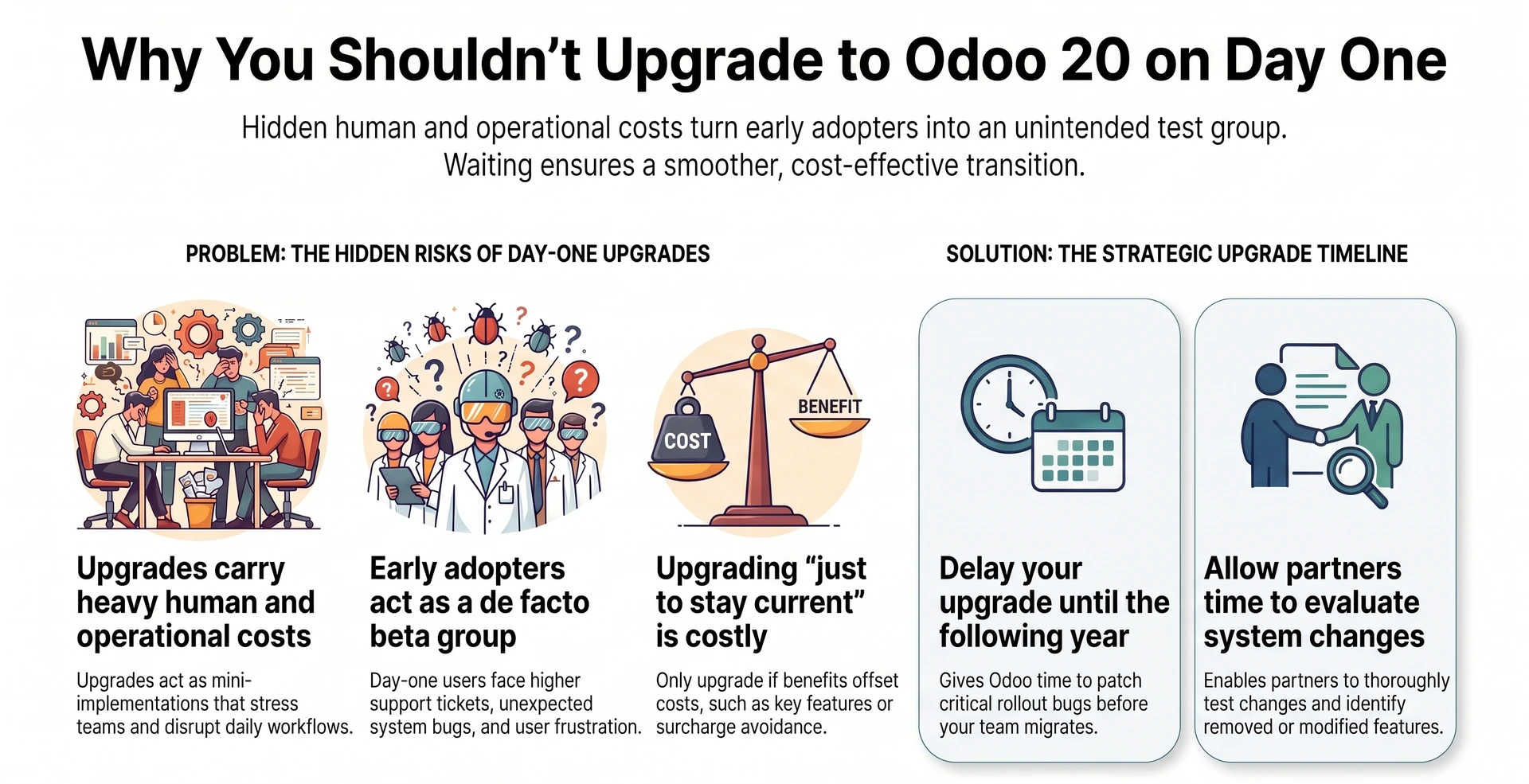
An upgrade to Odoo 20 is effectively a mini-implementation. Depending on your team size and adaptability, unexpected interface changes or altered business logic in Odoo 20 can create friction, disrupt daily workflows, and temporarily set your operations back.
Cost vs. Benefit Analysis
Before scheduling an upgrade, your organization must establish a clear justification:
- What is the tangible upside? Are you unlocking essential new feature sets, or avoiding Odoo's 25% surcharge applied to significantly outdated software versions?
- Does the ROI outweigh the friction? Upgrading purely to be on the "latest and greatest" version is a high-risk strategy. Unless you can define concrete business drivers, staying on your current stable release is usually the safer choice.
Hidden Cost #2: Becoming Odoo’s "De Facto Beta Group"
Odoo ERP is a vast, integrated business platform with hundreds of interconnected modules and workflows. Because of the software's sheer scale, exhaustive real-world testing across every edge case prior to launch is extremely difficult.
When you upgrade to Odoo 20 on day one, your organization effectively becomes part of Odoo’s de facto beta testing group. In practical business terms, early adoption leads to:
- Increased Support Tickets: Encountering unaddressed system bugs or workflow glitches in early builds.
- User Frustration and Pushback: Staff getting overwhelmed when routine tasks fail or behave unpredictably.
- Operational Downtime: Productivity loss while waiting for patch updates or vendor fixes.
Reflecting on past major version rollouts, such as Odoo 19, demonstrates how turbulent early releases can be for early adopters. Avoiding this friction protects user morale and operational continuity.
Strategic Timeline: When Should You Upgrade to Odoo 20?
Rather than rushing into a day-one upgrade, Odocore recommends letting Odoo 20 "breathe" before migrating your production database.
The Recommended Waiting Period
As a general rule for enterprise clients, holding off on upgrading until at least the first of the following year (or several months post-launch) is recommended. This waiting period provides critical advantages:
- Bug Remediation: Early adopters wade through initial stability issues, allowing Odoo's core development team time to push critical patches and bug fixes.
- Feature Clarity: Any deprecated features, altered configurations, or removed tools become fully documented and understood.
- Partner Readiness: Implementation partners gain essential hands-on experience identifying edge-case issues across diverse client environments before upgrading your core systems.
How Odocore Ensures a Safe and Seamless Odoo ERP Migration
As a certified Odoo Silver Partner in Pakistan, Odocore provides end-to-end Odoo ERP implementation, custom development, and migration consulting tailored to your business needs.
Instead of taking unnecessary day-one risks, our structured upgrade strategy includes:
- Upgrade Audit & Gap Analysis: Evaluating your current Odoo database, custom modules, and third-party integrations against Odoo 20.
- Staging & Test Migrations: Running full trial migrations in a secure test sandbox to catch bugs and verify workflows before touching live data.
- Change Management & Staff Training: Ensuring your team is fully prepared and confident before go-live.
Ready to Optimize Your Odoo ERP Strategy?
Whether you need guidance on Odoo 20, ongoing Odoo support in Pakistan, or custom ERP development, Odocore is here to help your enterprise scale securely.
Contact Odocore Today at odocore.com to schedule a free consultation with our certified Odoo experts!