
1. Introduction: Understanding the Foundation of Your ERP
From an architectural standpoint, hosting is the primary constraint on functional scalability and the critical foundation of any Odoo implementation. This choice dictates the long-term trajectory of the software's evolution and defines how the business will interact with its data. Technically, Odoo hosting is defined as the specific environment where the application, the database, and all associated files are stored. When an end-user accesses the system through a web browser, they are connecting directly to this environment to execute business logic.
At OdoCore (odocore.com), we act as the authoritative guide for navigating these complex infrastructure decisions. Selecting the right "home" for your enterprise data requires a strategic evaluation of your internal resources, beginning with Odoo’s most streamlined and maintenance-free path: Odoo Online.
2. Odoo Online: The "Fully Furnished" SaaS Experience
For organizations prioritizing rapid speed-to-market and the total elimination of technical debt, the "Software as a Service" (SaaS) model provides significant strategic value. Architecturally, this model functions as a "plug-and-play" solution where the user simply creates an account to begin immediate operations.
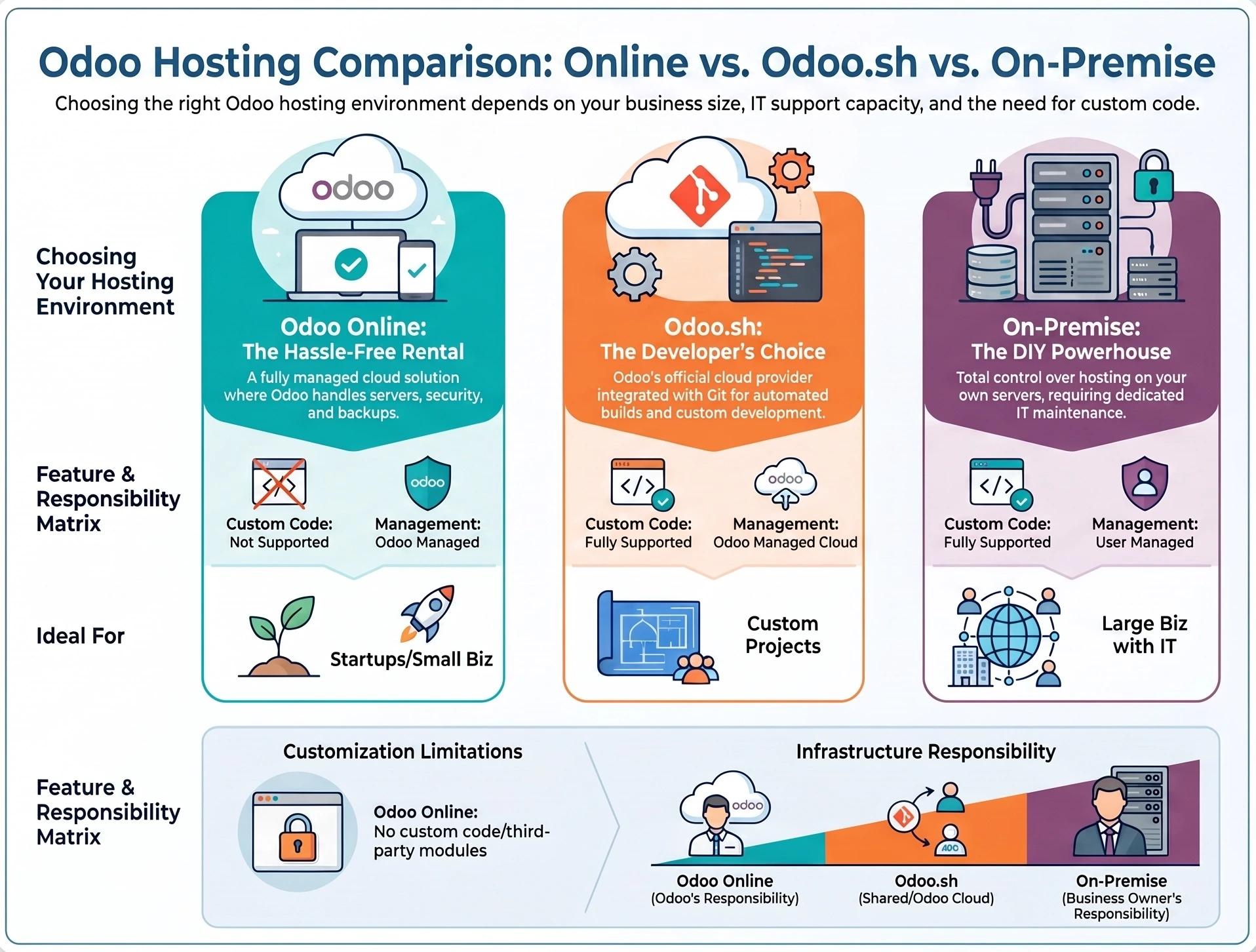
This environment is best interpreted through the metaphor of a "fully furnished apartment," where every structural and utility requirement is pre-configured for the tenant. Within this managed service framework, Odoo assumes full responsibility for the server infrastructure, automated backups, proactive maintenance, security protocols, and all software updates. By selecting this path, a business effectively trades sovereignty for speed.
While Odoo Online is the optimal choice for startups and small businesses, it carries a definitive architectural boundary. The platform prohibits the use of custom codes or bespoke modules. This "major limitation" means that any organization requiring specialized functional modifications will eventually outgrow this environment. When a "fully furnished" solution can no longer support unique business logic, the organization must transition to the flexible, joint-responsibility model of Odoo.sh.
3. Odoo.sh: The Developer’s Cloud Powerhouse
The rise of "Platform as a Service" (PaaS) has introduced a vital bridge between the rigid simplicity of SaaS and the complex overhead of On-Premise hosting. Odoo.sh is Odoo’s official cloud provider, specifically engineered for developers and businesses that must leverage custom code to maintain a competitive advantage.
Operating under the metaphor of "renting a customizable apartment," Odoo.sh provides the core infrastructure while granting the tenant the freedom to perform deep internal logic modifications. The strategic "So What?" of this platform is its deep integration with Git repositories. In this workflow, pushing code to the repository triggers an automated pipeline that builds and deploys the application without manual intervention.
To mitigate operational risk, Odoo.sh provides a sophisticated environment management system featuring dedicated branches for development, staging, and production. This three-tier structure ensures that testing and deployment are streamlined and isolated from the live database. For the growing enterprise, Odoo.sh is the premier choice for custom-built environments. OdoCore (odocore.com) provides the technical expertise required to architect and manage these high-performance development pipelines.
4. Odoo On-Premise: Total Control and Responsibility
For organizations that require absolute sovereignty over their server architecture and data residency, On-Premise hosting is a strategic necessity. This path represents a shift from "renting" infrastructure to "owning" the entire technology stack.
The metaphorical model for On-Premise hosting is "building a house from design to maintenance," where the business assumes total responsibility for the system's integrity and troubleshooting. This deployment can be executed using internal physical hardware or through external cloud providers such as AWS or DigitalOcean.
The administrative burden of this choice is substantial and requires a high-functioning IT support team. The internal team is responsible for the Ubuntu installation, the specific Odoo configuration, SSL certificate management, and the execution of major version upgrades. Consequently, this path is exclusively reserved for large businesses with the technical resources to manage the entire lifecycle of the server.
5. Strategic Summary and Final Verdict
The selection of a hosting environment is not a one-size-fits-all decision; it is a calculation of the balance between a company's internal technical maturity and its need for functional customization. Whether an organization chooses the zero-overhead path of a managed service or the total control of a private server, the decision must align with the long-term scalability of the business.
Odoo Hosting Comparison Matrix
Hosting Option | Metaphor | Management Responsibility | Custom Code Support | Ideal Business Profile |
Odoo Online | Fully Furnished Apartment | Fully Managed by Odoo | No Custom Code/Modules | Startups & Small Businesses |
Odoo.sh | Customizable Apartment | Joint Responsibility | Full Custom Code Support | Developers & Growing SMBs |
On-Premise | Building a House | Internal IT Managed | Full Customization | Large Enterprises with High IT Support |
Choosing the right foundation is the most critical step in your digital transformation. For further guidance and architectural analysis on your Odoo journey, visit odocore.com.