
Are you struggling to get value from AI in your Odoo ERP? Learn the 3 common mistakes businesses make when integrating AI with Odoo, and how to become a better "AI boss" to unlock massive productivity gains.
Artificial Intelligence (AI) is no longer a futuristic concept—it is actively reshaping how businesses manage their operations. In the world of enterprise resource planning, Odoo ERP stands out as one of the most flexible, modular, and powerful platforms available. Naturally, integrating AI into Odoo has become a top priority for businesses looking to automate tasks, improve decision-making, and scale their workflows.
However, many business leaders and Odoo managers run into a frustrating wall. They try using AI, find the results underwhelming, and declare: "AI is useless for my business."
But here is the hard truth: Your AI isn't dumb; you might just be a bad boss.
Think about it this way: if you hired a highly talented human employee, gave them zero training, zero context, and no clear definition of success, you wouldn't be surprised when they failed. Yet, we do exactly this with AI and then get frustrated when it doesn't deliver miracles.
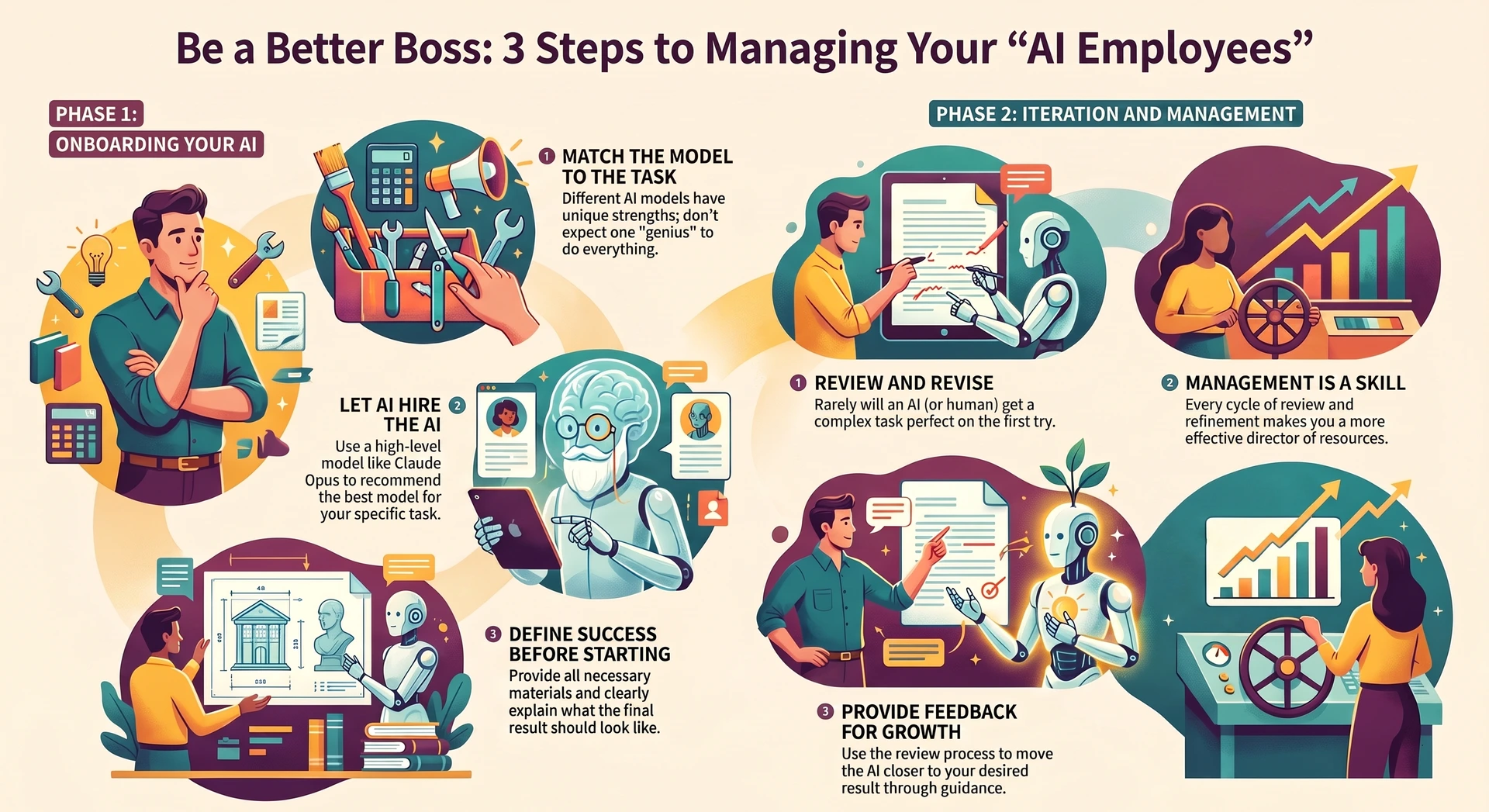
To help you unlock the true potential of AI within your Odoo environment, this article breaks down the three common mistakes businesses make and how to apply proven management principles to get the most out of your "AI employees."
Mistake #1: Treating AI as a One-Size-Fits-All Genius (Choosing the Correct "Employee")
When businesses look at AI, they often fall into the "Hollywood trap"—viewing AI as a singular, omnipotent genius that can excel at absolutely everything.
While the "Big Four" foundational models are becoming incredibly capable, treating AI as a generalist is neither efficient nor cost-effective for your business operations.
In your physical business, you would never:
- Ask your bookkeeper to fix your delivery van.
- Task your salesperson (who excels at relationships but struggles with numbers) with running your engineering department.
The same logic applies to AI. Just like human team members, different AI models have unique strengths, weaknesses, and specialties:
- Image Recognition & Vision: Perfect for scanning warehouse inventory, reading receipts, or analyzing product defects.
- Complex Reasoning: Ideal for analyzing financial forecasting, custom Odoo module logic, or solving multi-step workflow bottlenecks.
- Brute-Force Execution: Great for powering through repetitive, mind-numbing data entry tasks (like migrating legacy customer lists into Odoo CRM).
The Solution: Let AI Hire the AI
You don't need to become an expert on every emerging AI model to make the right choice. Instead, delegate the selection process to AI itself.
For instance, you can use a powerful model like Claude (specifically Claude Opus) as your "HR Manager" to recruit the right model for the job. Try using this master prompt:
Master Prompt for Selecting an AI Model: "I am looking at doing [insert specific task or Odoo workflow here], and I want to use AI to help me do it. Which AI model should I use to do this efficiently and effectively?"
By matching the right AI "employee" to the specific business task, you'll see a massive leap in accuracy and a dramatic reduction in compute costs.
Mistake #2: Providing Zero Context and Expecting Magic (Defining Success)
The second most crucial skill in managing AI (and human employees) is giving them the necessary materials and explaining exactly what you want. Most importantly, you must define what success looks like ahead of time.
Many managers open an AI prompt, type a vague instruction like "Help me draft a marketing campaign in Odoo CRM," and get upset when the output is generic.
The Solution: Use the "Review Checklist" Test
Modern AI models are getting smart enough to ask you for the materials they need. However, they cannot guess your internal standards for success.
Before handing off any task to an AI model or integrating an automated AI workflow in Odoo, ask yourself this question:
"When I review this work, what specific criteria am I looking for to make sure the job is done perfectly?"
If you cannot answer that question, you are not ready to delegate the task to anyone—human or machine.
If you are struggling to define success, you can actually use AI to brainstorm the criteria with you. But you must take ownership of the final standard. Don't expect AI to know what success looks like if you don't know yourself.
Mistake #3: The "One-and-Done" Expectation (Reviewing and Revising)
The third common mistake is expecting perfection on the very first try.
No human employee walks into a business and executes a complex task flawlessly without feedback. Yet, when an AI model outputs a draft that is only 80% correct, many managers throw their hands up and abandon the tool.
The Solution: Build an Iterative Feedback Loop
A good boss knows how to review work effectively and provide constructive feedback to steer the employee closer to the desired goal. To get the best results from AI:
- Be Patient: Expect that complex tasks will require an iterative, back-and-forth session.
- Provide Specific Feedback: Don't just say "make it better." Point out exactly what needs adjusting (e.g., "The tone is too formal, make it more conversational" or "The product descriptions must emphasize the Odoo ERP integration features").
- Refine Your System: Every time you go through this iterative process, you will become a better "boss"—refining your prompts, clarifying your business context, and learning how to direct your digital resources more effectively.
Unleashing the Power of AI in Odoo ERP
Applying these three principles—choosing the right model, defining success clearly, and committing to an iterative review process—will completely transform how your business utilizes AI.
At Odocore, we specialize in helping businesses bridge the gap between advanced technology and real-world execution. Whether you need to integrate cutting-edge AI models into your custom Odoo ERP workflows, optimize your database, or train your team to manage their digital resources, we are here to help.
Becoming a better AI manager takes time, but the payoff is immense. By learning how to direct your AI resources effectively, you will build a more scalable, efficient, and profitable business.